Emergent Becomes a Unicorn: How This AI App-Building Startup Rose So Fast
Emergent Becomes a Unicorn: How This AI App-Building Startup Rose So Fast
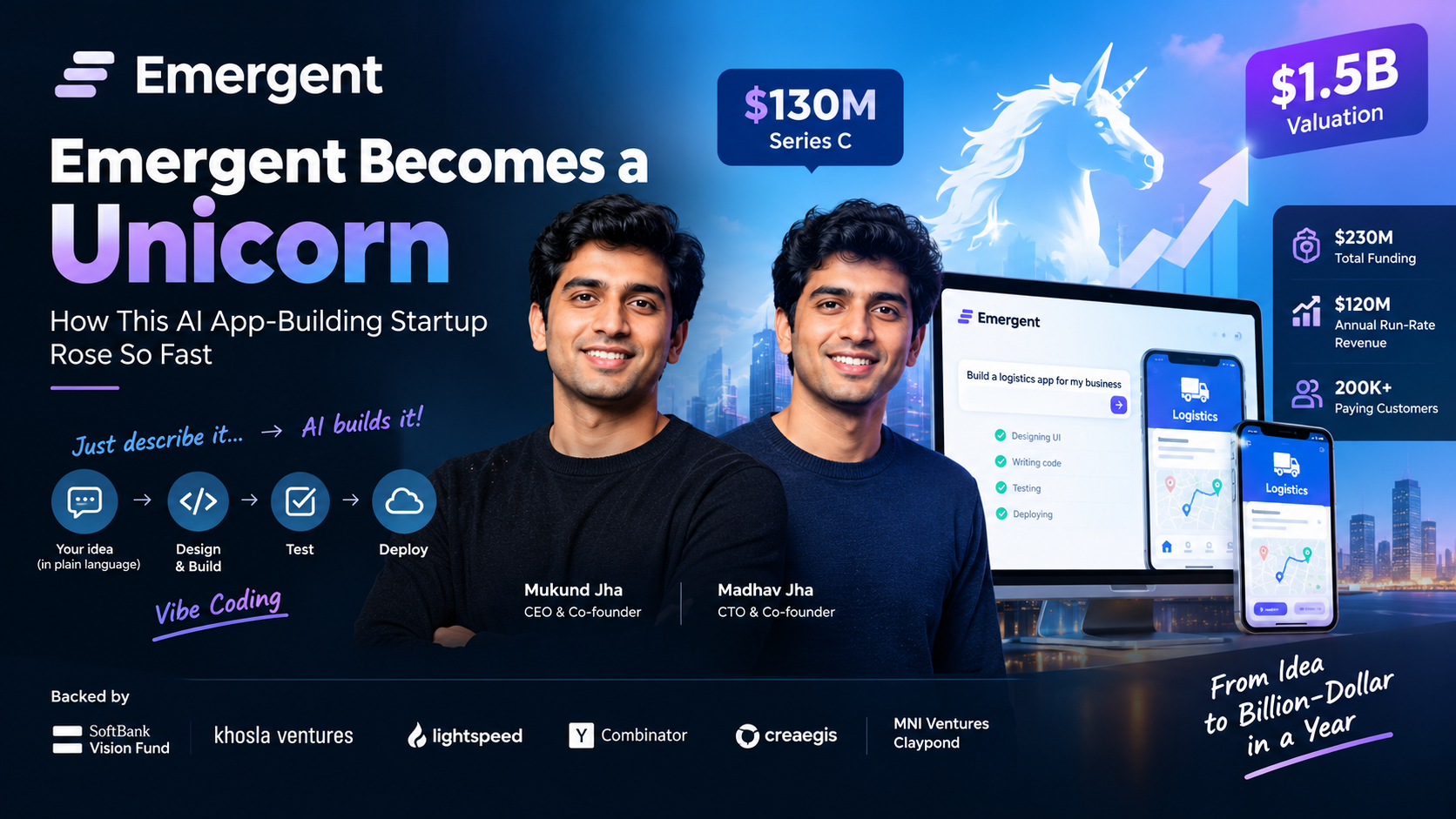
Not long ago, building a working app meant hiring developers, spending months on it, and paying a lot. Emergent believes this is ending. The AI startup, co-founded by twin brothers Mukund and Madhav Jha, has gone from a young launch to a billion-dollar company in roughly a year.
What Is Emergent?
Emergent is an AI-powered platform for building software with natural-language prompts, an approach often called "vibe coding." Users describe what they want, and AI agents handle design, building, testing, and deployment.
According to the company, its platform supports full-stack web and mobile apps, and its main audience is entrepreneurs and small businesses that lack large engineering teams.
Mukund Jha, formerly of Dunzo, started Emergent with his brother Madhav, who serves as CTO.
The Latest News: $130 Million Series C
In July 2026, Emergent raised $130 million in an Emergent Series C at a $1.5 billion post-money valuation, a five-fold jump in six months. That makes it a unicorn.
Key Numbers at a Glance
| Detail | Figure |
|
Series C |
$130 million |
|
Post-money valuation |
$1.5 billion |
|
Total funding raised |
About $230 million |
|
Annual run-rate revenue |
About $120 million |
|
Paying customers |
200,000+ |
|
Previous valuation (Series B, January 2026) |
$300 million |
Jha said run-rate revenue is up 70% in the last four months. The round was led by Creaegis, with new investors MNI Ventures-Claypond and Sentinel Global joining existing backers Khosla Ventures, SoftBank's Vision Fund 2, Lightspeed, and Y Combinator.
A Timeline of Rapid Growth
Emergent's funding history shows how quickly things moved:
September 2025: A $23 million Series A led by Lightspeed, following a $7 million seed round.
January 2026: A $70 million Series B led by SoftBank Vision Fund and Khosla Ventures.
February 2026: The company said it had reached a $100 million annual recurring revenue run rate, and launched a mobile app for building and publishing apps to the App Store and Google Play.
July 2026: The $130 million Series C and unicorn status.
Who Is Emergent Built For?
Unlike tools aimed mainly at developers, Emergent targets small and medium businesses. Its customers span logistics, manufacturing, construction, and property management, and Jha describes these firms as often running on spreadsheets and messaging apps.
The pitch is simple: turn the way a business already works into software, without a development team.
What the CEO Is Saying Now
Recent comments from Mukund Jha show where the company is heading.
AI writes most of the code: Speaking at the Moneycontrol Startup Conclave 2026, Jha said about 90% of Emergent's shipped code is AI-generated.
Growth is global: More than 30,000 businesses use its tools daily, with faster growth in Western markets and India making up about 10% of revenue.
A word of caution: He warned of "AI slop," meaning low-quality code that piles up when humans stop supervising.
A shift in focus: He told the ET Startup Awards 2026 that Emergent is moving from AI software toward business automation.
He has been open about weaknesses too. Jha acknowledged that design remains a weakness, since many AI-built websites tend to look alike.
Competition: A Crowded Race
Emergent is not alone. Rivals such as Lovable, Replit and Cursor have raised billions, while AI labs including OpenAI and Anthropic are pushing deeper into coding. Jha calls Replit his closest rival.
Fast growth also brings risk. As Dealroom noted earlier this year, expanding at this pace can strain infrastructure, support, and product quality.
What's Next for Emergent?
Product and research: The funding will go toward improving the success rate of apps built on the platform and its core AI agent workflows.
Hiring: The company had about 200 employees, mostly in Bengaluru, and planned to add 30 to 40 people in San Francisco by year-end.
Europe: It is considering a European office, where it sees significant traction.
Community: Emergent is backing Vibecon in San Francisco, a builder event offering a possible fast track to a Y Combinator interview and more than $15,000 in prizes. Applications close October 15, 2026.
Why This News Matters
Emergent's rise shows how fast AI application companies can scale on top of large language models. It also signals that software creation may be opening up to people who have never written code.
For India's startup scene, it is a notable comeback story for a founder whose earlier venture, Dunzo, shut down. For investors, it shows continued appetite for AI coding tools despite heavy competition.
Conclusion
In about a year, Emergent has gone from a young startup to a billion-dollar company, backed by SoftBank, Khosla Ventures, and Y Combinator. The next test is whether it can keep quality high while growing quickly, and whether its shift toward business automation sets it apart from larger rivals.
Frequently Asked Questions (FAQs)
1. What is Emergent AI?
Emergent is an AI platform that lets users build, deploy, and publish web and mobile apps by describing them in plain language. It targets entrepreneurs and small businesses.
2. How much funding has Emergent raised?
About $230 million in total, including a $130 million Series C at a $1.5 billion valuation in July 2026.
3. Who founded Emergent?
Twin brothers Mukund Jha (CEO, formerly of Dunzo) and Madhav Jha (CTO).
4. Who are Emergent's main competitors?
Replit, Lovable, and Cursor, along with the coding tools from AI labs such as OpenAI and Anthropic. Jha names Replit as the closest rival.
5. What is vibe coding?
Vibe coding means creating software by describing what you want in natural language and letting AI write and assemble the code.
Want more stories like this: Visit Trendzyvibe for the latest breaking news, trending stories, and in-depth updates on technology, startups, and more.
Leave a Reply
Your email address will not be published. Required fields are marked *