Meta Muse Spark Open: Specs, Benchmarks, License and Availability
Meta Muse Spark Open: Features, Benchmarks, Pricing and Specs
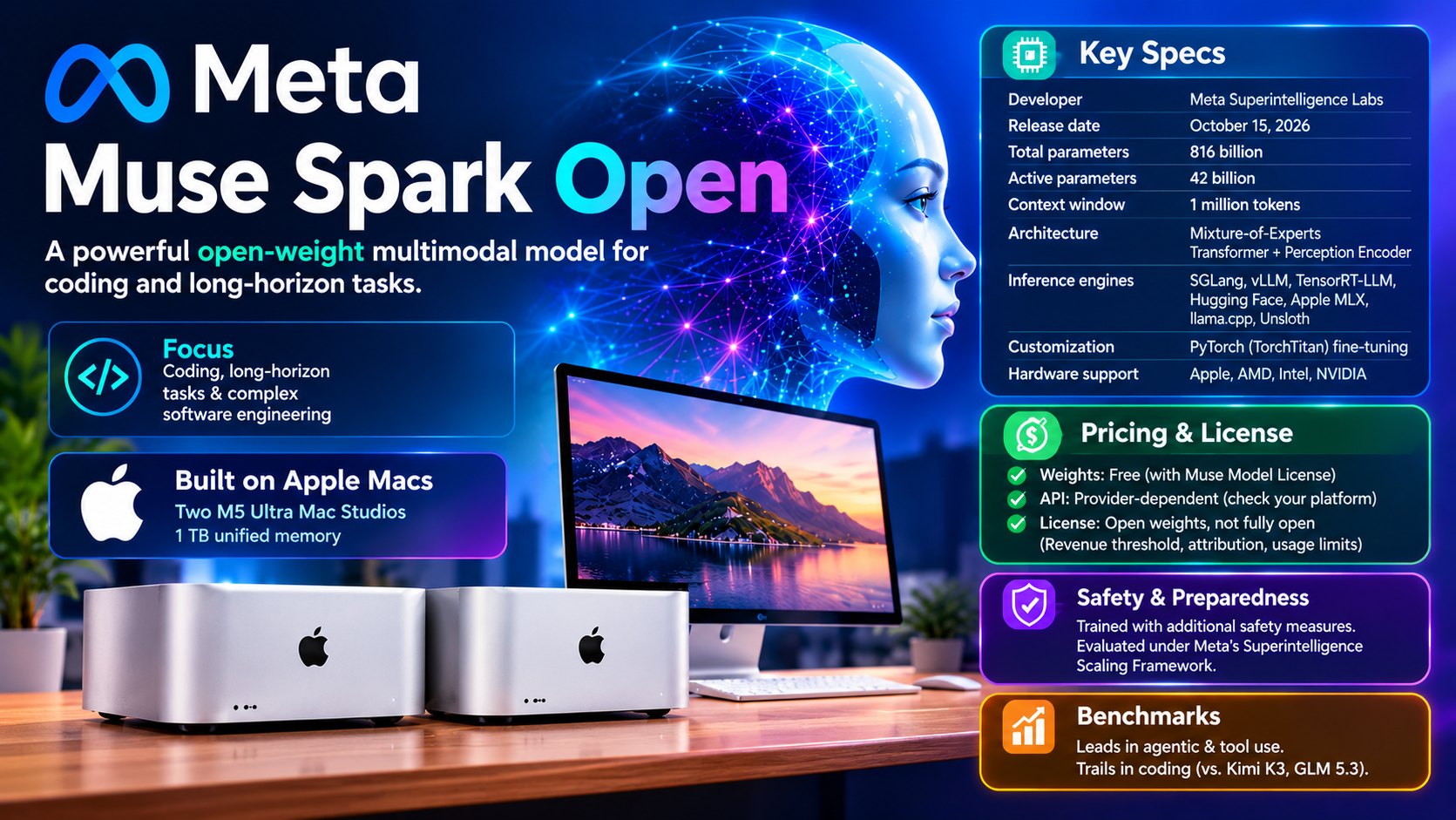
Meta has returned to open-weight AI with its most capable release yet. On October 15, 2026, the company published the weights for Muse Spark Open, a large multimodal model built for coding and autonomous agent work. It also comes with an unusual hardware story, since Meta worked with Apple to make it on desktop Macs.
The release matters because Meta spent most of 2026 on a closed strategy. Its first Muse model was proprietary, and developers had spent months wondering whether the company would keep its open-source promises. This launch is the clearest answer so far, with some important caveats.
What Is Muse Spark Open?
Muse Spark Open is the meta open-weight model of Meta's Muse Spark line, developed by Meta Superintelligence Labs. Meta describes it as natively multimodal and designed for long-horizon tasks, complex software engineering, and multi-step reasoning.
Key facts at a glance
Developer: Meta Superintelligence Labs
Release date: October 15, 2026
Total parameters: 816 billion
Active parameters: 42 billion
Context window: 1 million tokens
Focus: coding, agents, multi-step reasoning
License: Muse Model License (limited commercial terms)
Background: How Meta Got Here
The Muse family arrived in stages, which explains why this release drew so much attention.
|
Date |
Milestone |
|
April 8, 2026 |
Meta unveils Muse Spark, the first model from Meta Superintelligence Labs. It is proprietary, and Meta says open versions will follow |
|
July 9, 2026 |
Muse Spark 1.1 launches |
|
August 10, 2026 |
Meta releases Muse Glimmer, a 30B open-weight model that runs on a 24 GB consumer GPU |
|
October 15, 2026 |
Meta releases the Muse Spark Open weights |
At the April launch, Mark Zuckerberg said the Muse family would eventually include new open-source models. Reports at the time described the first release as a break from the Llama era. Muse Spark Open is the larger follow-through on that promise.
Muse Spark Open Specs
|
Spec |
Detail |
|
Architecture |
Mixture-of-Experts Transformer with Perception Encoder |
|
Parameters |
816B open model, 42B active |
|
Context window |
1M tokens |
|
Input |
Natively multimodal |
|
Best suited for |
Coding, agentic workflows, long-horizon tasks |
|
Inference engines |
SGLang, vLLM, TensorRT-LLM, Hugging Face Transformers, Apple MLX, llama.cpp, Unsloth |
|
Customization |
PyTorch (TorchTitan) fine-tuning |
|
Hardware optimization |
Apple, AMD, Intel, and NVIDIA silicon |
Meta also shipped custom GPU kernels called Helion for SGLang. The company says they deliver kernel-level speedups of roughly 1.03x to 3.95x on NVIDIA and AMD GPUs, plus a 3% end-to-end gain on AMD's MI350 chip.
Where It Leads and Where It Trails
All figures below come from Meta's own evaluations. Independent testing is still limited, so treat them as a starting point.
Against US open models
Meta compares Muse Spark Open mainly with two American rivals, Thinking Machines' Inkling and Nvidia's Nemotron 3 Ultra. According to The New Stack, Meta's results show the new model ahead across the board, often by 20 points or more.
Against Chinese open models
The tougher competition comes from open models many developers already run, including Kimi K3, GLM 5.3, and Qwen3.8. Here the picture is mixed:
Agentic and tool use: Muse Spark Open leads on benchmarks such as JobBench and MCP-Atlas.
Science coding: It roughly ties the field on SciCode.
Coding: It trails. On Terminal-Bench 2.1, it scores 76.4 against 85.0 for Kimi K3 and 83.9 for GLM 5.3. On DeepSWE 1.1, the gap runs about 60 against 68.
Coding was already a stated weak spot when Meta launched the closed Muse Spark in April. That is notable, because coding is also one of the use cases Meta highlights for this model.
What the numbers mean
For teams building agents that call tools, browse, and chain many steps, Muse Spark Open looks like a serious contender. For pure terminal and software-repair work, some rivals still look stronger on paper. Real workloads often behave differently from Muse Spark Open benchmarks, so testing on your own tasks matters.
Running It on a Mac: The Apple Partnership
The most unexpected part of the launch is the Apple collaboration. Meta says Muse Spark Open is the first model in its class to run on a desktop, using two Apple M5 Ultra Mac Studios with the latest MLX framework.
The setup works like this:
Each Mac Studio offers up to 512 GB of unified memory.
Two machines linked together act like a single system with about 1 TB of memory.
The M5 Ultra's 1.2 TB/s of memory bandwidth is fast enough to read the small slice of the model each token needs.
Meta says it tested on-device agent workflows, including shipping iOS fixes and features to the open-source Ice Cubes Mastodon client, and driving DaVinci Resolve to find and crop strong video moments. Both Zuckerberg and Apple CEO John Ternus promoted the collaboration publicly.
There is a practical catch. As The New Stack notes, Apple does not currently sell the 512 GB configuration to the general public. It is expected in a few weeks, and two units will cost about as much as a compact car. For most people, this is a signal of what is coming rather than something they can do today.
Where to Access Muse Spark Open
You do not need the Mac setup to use it. Meta lists two routes.
Hosted APIs: Baseten, Fireworks AI, Groq, Modal, Nebius, OpenRouter, and Together AI.
Weight downloads: Hugging Face, Amazon SageMaker AI, Google Cloud Model Garden, and Microsoft Foundry Models.
Pricing: Free Weights, Provider-Dependent API Costs
Downloading the weights is free. Meta says the license lets many developers use the model at no cost. If you use a hosted API, pricing is set by each provider. Meta's announcement does not publish a single price, so check your chosen platform for current rates.
The License: Open Weights, Not Fully Open
This is the part to read carefully. Meta calls it the Muse Model License, dated October 15, 2026. It permits free use, copying, modification, fine-tuning, distillation, and distribution, subject to conditions:
Revenue threshold: A company with more than $20 million in gross revenue in any twelve months must notify Meta and sign a separate written agreement before offering the model or its derivatives as part of a Model-as-a-Service business.
Attribution: Products or services using the model or its derivatives must prominently display "Built with Muse Spark Open."
Usage limits: The usage policy bars military and critical-infrastructure deployments.
Internal use and building the model into your own product are free. Analysts have compared the terms to those of some newer Chinese open models. The distinction between open-weight and open-source is a live debate in the industry, and this license falls on the open-weight side.
Safety and Preparedness
Meta says the open version received additional safety training because open weights carry their own risks. The company evaluated it under its Meta Superintelligence Scaling Framework, which covers the most severe risk categories, and says it met the thresholds required for release. Detailed results are in the Hugging Face model card, and a fuller evaluation report is promised soon.
Independent verification of those claims will be worth watching in the coming weeks.
Why This News Matters
Three things make this release significant:
It revives Meta's open-weight push: After a closed first release, developers now have a large Meta model they can download and modify.
It raises the bar for US open models: Meta says it is now the leading American open-weight option, in a field where Chinese labs have recently set the pace.
It points toward local frontier AI: Running a model of this scale on desktop hardware would have been unrealistic not long ago.
What Comes Next
Several questions remain open: independent benchmark results, real-world coding performance, how the license holds up with enterprise users, and whether Meta continues releasing open versions as the Muse line grows. Watch for third-party evaluations and the full safety report.
Conclusion
Muse Spark Open is a meaningful step for Meta and for open-weight AI in the United States. It offers strong agentic performance, a huge context window, and a path to running a large model on a desktop. It also comes with a restrictive license and a coding gap against the best Chinese open models. Whether it becomes developers' default choice will depend on independent testing and how the license is received.
Frequently Asked Questions
1. What is Meta Muse Spark Open?
It is Meta's open-weight multimodal AI model, released on October 15, 2026. It has 816 billion total parameters, 42 billion active parameters, and a 1 million-token context window, and it is built for coding and agentic tasks.
2. Is Muse Spark Open really open source?
It is open-weight, not fully open source. The weights are free to download, but the Muse Model License adds conditions, including a revenue threshold and a required "Built with Muse Spark Open" notice.
3. How much does Muse Spark Open cost?
The weights are free. Hosted API pricing depends on the provider, such as Together AI, Fireworks AI, Groq, or OpenRouter, so check each platform for current rates.
4. Can I run Muse Spark Open on my own computer?
Meta says it runs on two linked Apple M5 Ultra Mac Studios with 512 GB each, using MLX. That setup is expensive, and the 512 GB model is not yet widely sold. Most users will access it through hosted APIs or cloud platforms.
5. How does Muse Spark Open compare with other open models?
In Meta's tests, it beats US rivals like Inkling and Nemotron 3 Ultra, and it leads Kimi K3, GLM 5.3, and Qwen3.8 on several agentic benchmarks. It trails some Chinese models on coding tests such as Terminal-Bench 2.1 and DeepSWE 1.1.
Stay Updated with Trendzyvibe
Want more coverage of the AI launches reshaping tech? Visit Trendzyvibe for the latest breaking news, trending stories, and in-depth updates, and check back often for follow-ups on Muse Spark Open.
Leave a Reply
Your email address will not be published. Required fields are marked *